Payment Gateways
Checkout, subscriptions, refunds, and webhooks wired for reliability - not just a happy-path demo.
StripeRazorpayPayPalBraintree
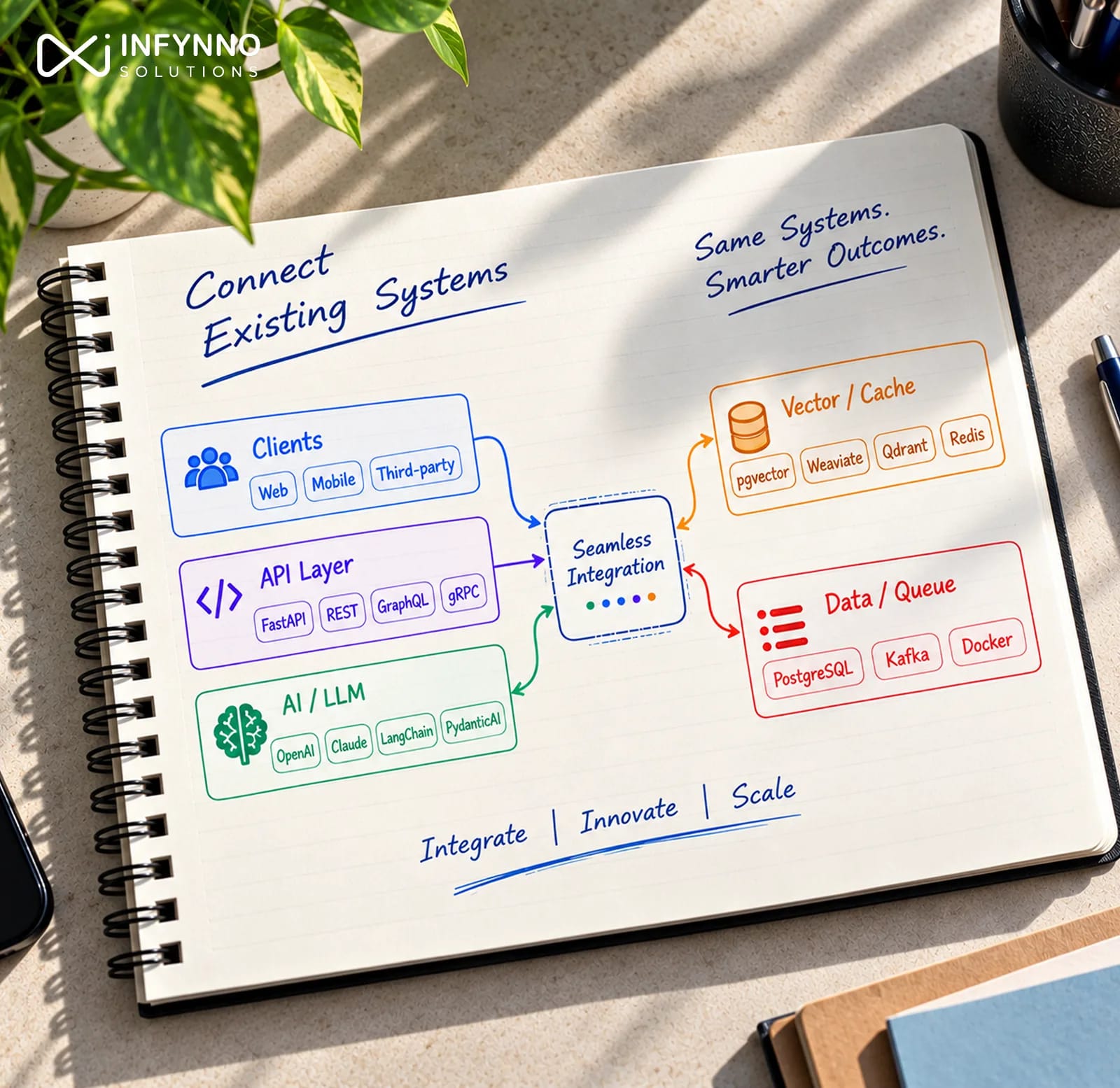
Your business doesn't need to start from scratch to benefit from AI. We integrate AI into existing products, enterprise systems, and business workflows using secure APIs, RAG architectures, AI orchestration, and modern integration patterns - helping you unlock intelligent capabilities without disrupting the software you already rely on.
8+
Years industry experience
15+
Countries served
170+
Projects delivered globally
5+
AI apps in production
FastAPI, REST, GraphQL, and gRPC - we select the right protocol based on your client types, data complexity, and performance requirements.
Our primary framework for AI-adjacent APIs - async-first, Pydantic-validated, auto-documented.
Deliverables
Best for: Async-first architecture handles multiple LLM calls and vector DB queries per request without blocking.
The architectural standard for web and mobile backends - built with consistent conventions and proper auth.
Deliverables
Best for: Built in Laravel, Node.js/Fastify, FastAPI, or NestJS - we match the framework to your existing stack.
For complex SaaS and EdTech platforms where frontend clients have highly variable data requirements.
Deliverables
Best for: Single endpoint, client-driven queries - eliminates over-fetching common in REST for data-rich dashboards.
For internal microservice communication where performance is the priority - especially AI inference pipelines.
Deliverables
Best for: Binary serialization + HTTP/2 multiplexing is dramatically faster than REST for AI inference pipeline fan-out.
OpenAI, Claude, LangChain, PydanticAI - and how we actually use each one in production.
OpenAI Integration
GPT-4o · Embeddings · Whisper
Production-grade OpenAI integration - not prototype experiments.
Chat Completions
GPT-4o chatbots, writing assistants, document analysis, classification
Embeddings
Semantic search, similarity matching, content recommendations
Assistants API
Persistent assistants with thread management and file retrieval
Whisper STT
Lecture transcription, voice input, session summarization
What we handle in production
Rate limit management with retry
Token counting & cost controls
Response streaming
Prompt versioning & A/B testing
Beyond AI
Our integration work isn't limited to AI and LLMs - we connect your product to the payment, auth, security, analytics, and CRM tools it actually runs on.
Checkout, subscriptions, refunds, and webhooks wired for reliability - not just a happy-path demo.
Publishing, scheduling, and engagement data pulled directly from the platforms your audience lives on.
Single sign-on and identity federation so users log in once and move across your systems securely.
Bot protection, secrets management, and vulnerability scanning built into the pipeline, not bolted on after.
Product and marketing analytics wired to fire accurately from day one - no orphaned events, no double counting.
Two-way sync between your product and the CRM your sales and support teams already work in.
pgvector, Weaviate, and Qdrant - each has a specific sweet spot. We recommend based on your dataset size, filtering requirements, and multi-tenancy needs.
pgvector
PostgreSQL Extension
Vector search inside your existing PostgreSQL database - zero additional infrastructure.
Best for: Already on PostgreSQL. Moderate dataset. Operational simplicity priority.
Weaviate
Purpose-Built Vector DB
Purpose-built for large-scale semantic search and RAG with native multi-tenancy.
Best for: Large datasets. Strict multi-tenant isolation. Complex hybrid search.
Qdrant
Rust-Powered Vector DB
Lowest retrieval latency. Advanced payload filtering. Rust-level performance.
Best for: Lowest latency requirement. Complex filtering conditions. Memory-efficient storage.
PostgreSQL, Redis, Kafka, and Docker - the production infrastructure that every AI system depends on.
Schema + index design for query patterns · Row-level security for multi-tenancy · JSONB + GIN for semi-structured data · pgvector for vector search · Read replicas + PgBouncer pooling
LLM response semantic caching (30-60% cost reduction) · Sliding window rate limiting per user/endpoint · Conversation history with TTL expiry · Async task queue with Celery / BullMQ
AI pipeline event streaming at scale · Decoupled microservice communication · CDC via Debezium for vector DB sync · Consumer group scaling for parallel processing
Every AI service containerized independently · Multi-stage builds for minimal production images · Docker Compose for full local stack · ECS / GKE / Cloud Run production deployment
Every AI integration project starts with a documented architecture - reviewed and approved before development begins.
01
Every AI feature mapped to specific technical components - LLM, vector DB, API protocol, caching strategy.
02
Complete data flow documented - from source through processing pipeline to response delivery. Every service boundary defined.
03
REST vs GraphQL vs gRPC. pgvector vs Weaviate vs Qdrant. OpenAI vs Claude. Each decision justified against your specific requirements.
04
Designed for 10x scale - rate limiting, caching, queue-based processing, horizontal scaling, and circuit breakers from Day 1.
05
API auth, authorization, encryption, PII handling, audit logging, and secret management - designed before implementation, not after.
06
Service diagrams, data flow, API contracts, DB schema, deployment topology - approved before development begins.
Embed → store → retrieve → inject into LLM context → generate with citations. Used in EdTech chatbots, compliance Q&A, knowledge bases.
AI agents using tools - search, DB queries, API calls, calculations. Built with LangChain, LangGraph, or PydanticAI.
Server-sent events from FastAPI streaming token-by-token to clients - standard for conversational AI where perceived latency matters.
Long-running tasks (essay scoring, doc processing) queued in Redis/Kafka, processed by workers, results delivered via webhook.
LLM responses cached by embedding similarity - reduces API costs 30-60% on platforms with high query repetition.
GPT-4o for complex reasoning, GPT-4o-mini for classification, Claude for long documents - routed by task type, cost, and latency.
Dense vector + BM25 keyword search combined - consistently outperforms either alone for retrieval quality in production.
DB change events via Kafka CDC trigger vector DB embedding updates - keeping semantic search fresh without manual sync jobs.
You need engineers who understand both the AI layer and the API infrastructure layer - and can design production-grade architecture from Day 1.
You need specialist expertise for LangChain, vector databases, and RAG pipelines - working alongside your team or owning the AI infrastructure layer.
Your prototype works in demos but is slow under load and expensive at scale. We've solved these production challenges before.
You have existing APIs and databases. You need AI capabilities added as targeted integrations - without rebuilding your core systems.
AI integration and API development is the engineering work that makes AI features actually work in production - the FastAPI endpoints serving LLM calls, the RAG pipelines retrieving from vector databases, the async queues processing documents, and the caching layers keeping costs under control. It's the difference between an AI demo and a reliable production system.
FastAPI is our default for AI-adjacent APIs in Python - particularly when you're working with LLMs, vector databases, and ML models, where the Python ecosystem is most mature. Node.js (with Fastify or Express) is our choice when the team is JavaScript-native or when the API is primarily data-serving with minimal AI processing. Both support async operation equally well.
RAG (Retrieval-Augmented Generation) is the pattern that makes AI chatbots accurate for specific knowledge bases: documents are split into chunks, embedded into vectors, stored in a vector database, and retrieved by semantic similarity when a query arrives. The retrieved chunks are injected into the LLM prompt as context, grounding the response in your specific content rather than generic training data. We implement this with LangChain or LlamaIndex, using pgvector, Weaviate, or Qdrant for storage.
pgvector if you're already on PostgreSQL and want zero additional infrastructure - good for moderate-scale datasets. Weaviate for large-scale semantic search with strict multi-tenant isolation, native hybrid search, and built-in vectorization. Qdrant when lowest retrieval latency is the priority and you need complex payload filtering alongside vector similarity. We assess your specific requirements and recommend accordingly.
Primarily through semantic caching - storing LLM responses with their query embeddings and serving cached responses for sufficiently similar incoming queries. This typically reduces LLM API costs by 30-60% on platforms with high query repetition. We also implement multi-model routing (cheaper models for simple tasks), token counting and context management, and async processing to avoid wasted real-time API calls.
LangChain is a broad orchestration framework for LLM applications - providing composable abstractions for chains, agents, retrievers, and memory that work across many use cases. PydanticAI is a focused agent framework from the Pydantic team that prioritizes type safety and validation - ideal when you're building a FastAPI backend and want AI responses validated as typed Pydantic models before downstream use. We often use both: PydanticAI for the AI layer, LangChain for complex retrieval pipelines.
A focused RAG pipeline - document ingestion, vector storage, retrieval, and generation - can be production-ready in 2-4 weeks. A full AI product with conversational interface, admin dashboard, usage analytics, and monitoring typically takes 6-10 weeks. Timeline depends on data volume, retrieval complexity, and the breadth of features beyond the core pipeline.
Free technical discovery call. We'll map your requirements, recommend the right stack, and outline an architecture before any commitment.
Start building
Technical discovery call
Architecture documented
Stack and scope agreed
Development begins