OpenAI & LLM API Integration
Production-grade integration with OpenAI, Claude, Groq, and other LLM providers - function calling, structured output, streaming, and cost-aware model routing.
OpenAIClaudeGroqOllama
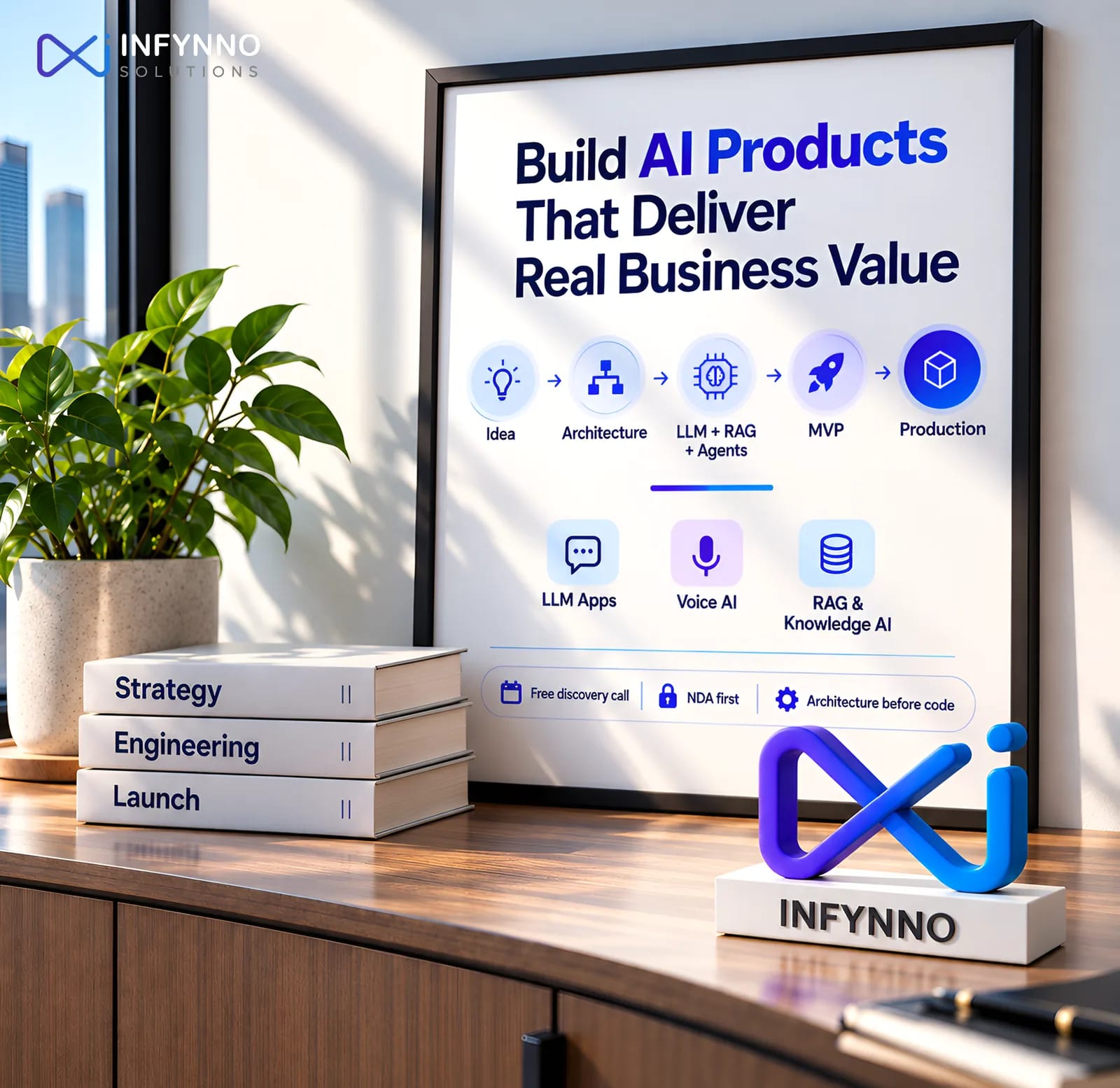
Whether you're building an AI-native startup, adding intelligent capabilities to an existing product, or launching a new AI-powered platform, we help you design, engineer, and scale production-ready AI products. From product strategy and architecture to LLM integration, RAG, AI agents, and deployment, we build AI solutions that create measurable business value.
8+
Years industry experience
15+
Countries served
170+
Projects delivered globally
5+
AI apps in production
Nine core offerings, all engineered for production - not proof-of-concept demos.
Production-grade integration with OpenAI, Claude, Groq, and other LLM providers - function calling, structured output, streaming, and cost-aware model routing.
AI-powered automation that removes manual work - document processing, approvals, notifications, and multi-step workflows triggered by real events.
RAG-based support chatbots trained on your policies and product docs - resolving routine queries and escalating to humans with full context.
Real-time voice agents that listen, understand, and respond naturally - inbound and outbound calls, multilingual, sub-second latency.
Curriculum-trained AI study assistants that answer student questions 24/7, grounded in your actual course content - not generic AI knowledge.
Chatbots trained on your internal docs, wikis, and knowledge bases - turning institutional knowledge into instant, cited answers.
Custom AI coding tools and agentic workflows that speed up engineering - code review, generation, and refactoring built into your dev process.
AI pipelines that turn Figma designs and mockups directly into production-ready components - cutting handoff time from days to hours.
Targeted AI features added into your existing product - smart search, content generation, summarization, and recommendations, shipped without a rebuild.
We are model-agnostic. We select the right LLM for your specific task, not the one with the best marketing.
Best general capability, function calling, structured output
We build with it:
Stateful AI agents with built-in tools: file search, web search, computer use
We build with it:
200K context, nuanced writing, safety-critical applications
We build with it:
10-20x faster than GPU inference - essential for real-time voice AI
We build with it:
Serverless inference for specialized and fine-tuned open-source models
We build with it:
Fine-tuning open-source models in production without managing GPU clusters
We build with it:
Access to 500,000+ models - the source for SOTA embedding, reranking & domain models
We build with it:
Full data sovereignty - runs LLMs locally, data never leaves your infrastructure
We build with it:
RAG is the difference between an AI that says something plausible and one that says something accurate and specific to your content.
Production RAG Pipeline Architecture
Convert text to dense vectors for semantic search. Model choice is foundational - it determines retrieval quality.
Cross-encoders that re-score retrieved chunks for true relevance. Consistently improves RAG accuracy by 15-30%.
ETL platform for complex real-world documents. Converts scanned PDFs, PowerPoints, tables, and HTML into clean LLM-ready text.
Five factors drive every technology decision: task requirements, latency, data privacy, cost, and existing infrastructure.
Not prototypes. Production systems that real users depend on every day.
Multilingual Voice AI Agent
Full generative AI voice stack: real-time conversations in 10+ languages with sub-second response latency.
AI Study Assistant
RAG-based AI study assistant trained on the full UCAT curriculum. 24/7 subject-specific guidance.
AI Compliance Agent
LLM-powered compliance monitoring with long-context regulatory document analysis and gap report generation.
Common questions before starting an engagement.
Generative AI refers to AI systems that generate new content - text, speech, images, code, or structured data - rather than just classifying existing content. In software, it most commonly refers to LLMs like GPT-4 and Claude that generate text, voice AI systems, and RAG-based knowledge systems.
We evaluate five factors: task requirements (reasoning complexity, context length, structured output needs), latency (real-time voice vs async), data privacy (cloud API vs on-premise Ollama), cost (token pricing vs query volume), and existing infrastructure. We often use multiple models in a single application, routing different tasks to the most appropriate model.
Claude excels at long-document analysis (200K token context), nuanced writing quality, safety-critical applications, and vision tasks with complex document images. GPT-4o is generally better for function calling, structured output, and the broadest integration ecosystem. Many production systems use both.
Yes. For applications where data cannot be sent to third-party APIs - regulated healthcare, financial data, student PII - Infynno deploys generative AI on-premise using Ollama with open-source models (Llama, Mistral, Phi-3). Full data sovereignty with the same generative AI capabilities.
Yes. We build AI-powered automation using n8n, Make.com, and custom Python pipelines - document processing, approval routing, notifications, and multi-step workflows triggered by real events. LLMs handle the parts of the workflow that require judgment: classification, extraction, and generation.
Yes. We build custom AI coding assistants and agentic workflows (built on tools like Claude Code) that speed up code review, generation, and refactoring inside your existing dev process. We also build design-to-code pipelines that convert Figma designs directly into production-ready components, cutting handoff time from days to hours.
Yes. Most of our generative AI work is feature-level - smart search, content generation, summarization, or recommendations added into an existing product via API integration. No rebuild, no rip-and-replace. We scope, build, and ship the feature on your existing architecture.
Start with a free discovery call. NDA before we go further.
Start building
1. Discovery call
2. NDA signed
3. Scope agreed
4. Delivery begins