AI-Powered Student Progress AnalysisMove Beyond Scores.
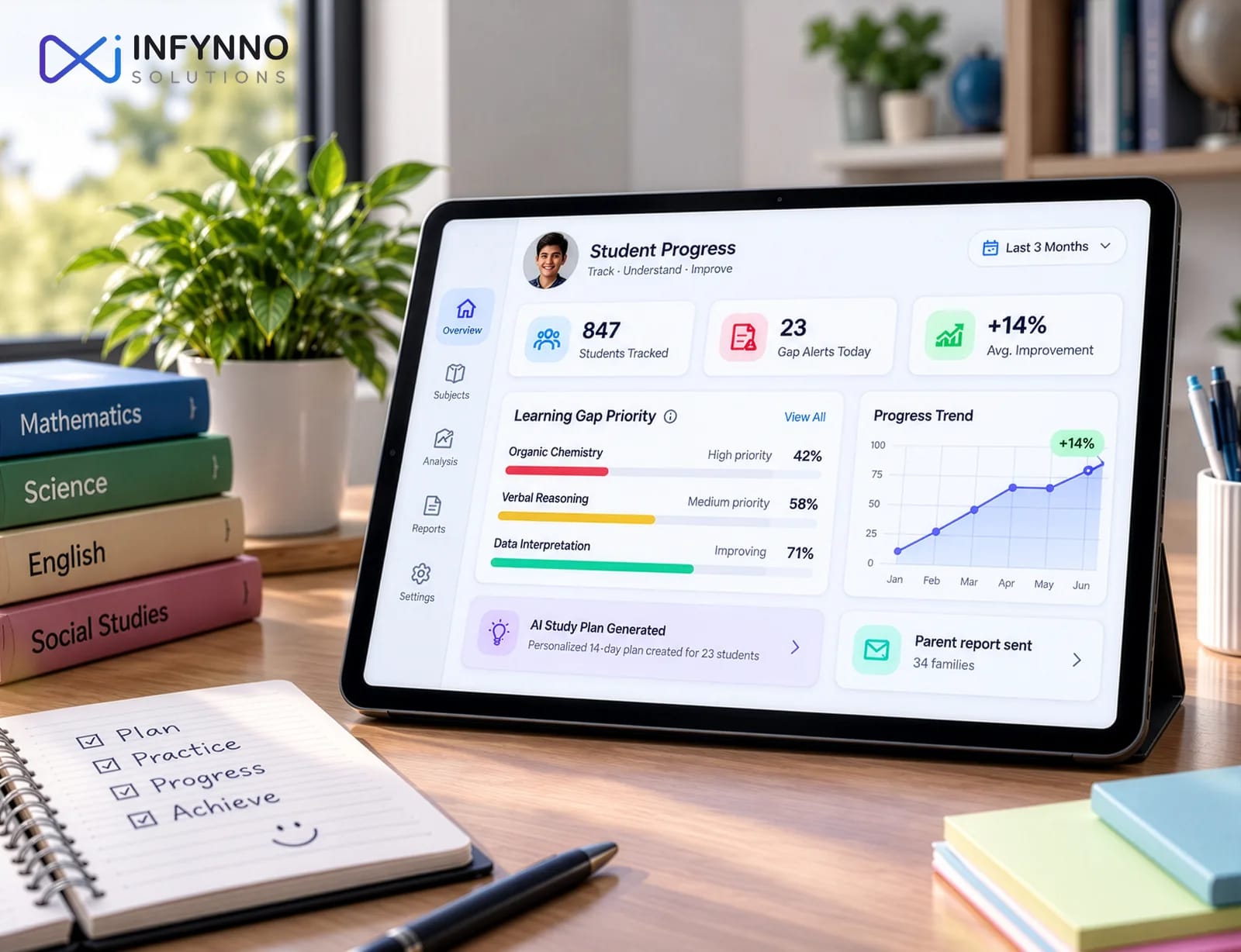
Raw scores tell you what happened. AI-powered progress analysis tells you why - and what to do next. Infynno builds intelligent student analytics that identify learning gaps, generate personalized study plans, and give parents plain-English progress reports.
30,000+
Students on platforms we've built
15+ Countries
AU · UK · USA · India · NZ + 10
8 AI Features
Analytics + AI + Dashboard
Add-on Ready
Build new or add to existing
Eight AI Features. One Intelligent Analytics System.
Click any feature to explore. Built to work as an integrated ecosystem - not disconnected modules.
Most students don't know what they don't know. AI learning gap analysis continuously analyzes each student's practice data - question by question, attempt by attempt - and identifies the specific topics, subtopics, and skill areas where their performance is weakest. It then automatically surfaces targeted questions to address those gaps.
What users see
Focus Areas dashboard with accuracy per topic
Targeted practice sets generated from gap analysis
Class-wide weak topic heatmap for educators
Plain-English "focus on…" summary for parents
Surface-level score reporting shows what a student got right or wrong. Deep performance analysis goes further - identifying recurring mistake patterns, tracking accuracy trends over time, and surfacing the insights that explain why a student is performing the way they are.
What users see
Subject & topic accuracy trend charts
Error-type breakdown per question category
Time-per-question analytics across topics
Performance vs class average by section
All analytics data is surfaced through a structured, visual dashboard - giving students, educators, and parents a clear, real-time picture of performance. Not a wall of numbers - designed to answer the questions students and educators actually ask.
What users see
8 distinct analytics views in one dashboard
Real-time data refresh after every practice session
Student, educator, and parent role-specific views
One-click practice launch from any weak-area view
Raw analytics data is valuable for engineers. Parents and students need something different: clear, plain-English explanations of what the data means and what to do about it. AI performance reports translate complex analytics into narratives that parents can act on and students can understand.
What users see
Student-facing narrative after every exam
Weekly parent email report with improvement indicators
Class-wide cohort insight report for educators
Branded PDF export with shareable link
Every student sits the same exam - but no two students need the same preparation path. AI curriculum generation creates a personalized study plan for each student based on their current performance, the official exam syllabus, their identified learning gaps, and their target exam date. The plan updates automatically as the student progresses.
What users see
Personalized daily study schedule with task links
Progress tracking against plan - % completed
Class-level plan adherence dashboard for educators
Automatic re-plan when exam date changes
Written responses are the most time-consuming assessments for educators and the most valuable for students. AI essay analysis scores written responses against configurable rubrics automatically, providing detailed criterion-by-criterion feedback - not just a grade.
What users see
Criterion-by-criterion score breakdown
Highlighted strengths and development areas
Consistency tracking across multiple submissions
Student improvement trend over time per criterion
Students spend hours manually creating flashcards. AI flashcard generation eliminates this entirely - students upload their content and receive a complete set of study flashcards automatically, ready for spaced repetition review.
What users see
Instant flashcard set from any uploaded document
Mastery tracking per flashcard concept
Spaced repetition queue updated daily
Deck sharing across student cohort
Students have questions at 11pm, on weekends, and in the middle of a practice session when no tutor is available. The AI Doubt Solver provides instant, subject-specific guidance - trained on your curriculum content and configured for your exam context.
What users see
24/7 instant answers from curriculum-trained AI
Unanswered questions surfaced to educators daily
Usage analytics - top questions by topic & time
Student feedback rating per response
Feature 01 of 8
AI Learning Gap Analysis
Most RequestedWhat users see
Focus Areas dashboard with accuracy per topic
Targeted practice sets generated from gap analysis
Class-wide weak topic heatmap for educators
Plain-English "focus on…" summary for parents
Most students don't know what they don't know. AI learning gap analysis continuously analyzes each student's practice data - question by question, attempt by attempt - and identifies the specific topics, subtopics, and skill areas where their performance is weakest. It then automatically surfaces targeted questions to address those gaps.
A Complete AI Analytics Ecosystem - Not Seven Disconnected Features
Each feature is powerful individually. The real value emerges when they work as an integrated system around a single student's learning journey.
The AI Learning Gap Analysis
identifies that a student struggles with abstract reasoning.
The AI Curriculum Generator
automatically adjusts the study plan to prioritize abstract reasoning practice.
The AI Doubt Solver
answers the student's abstract reasoning questions at 11pm when no tutor is available.
The AI Flashcard Generator
creates flashcards from abstract reasoning notes the student uploaded.
The Deep Performance Analysis
identifies accuracy improves in untimed practice but drops under exam conditions - revealing time pressure as the real issue.
The AI Performance Report
tells the parent, in plain English: "Your child understands the concepts but needs timed practice to build speed".
The AI Essay Scoring
provides detailed feedback on the written response practice - the one assessment type that previously required waiting days for a tutor.
Seven features. One coherent system.
One student who is better prepared because your platform actually understands them.
Who Adds AI Progress Analysis to Their Platform
EdTech Founders
You have a question bank and a mock exam engine. You need the analytics layer that transforms raw practice data into personalized guidance - making your platform genuinely smarter than a static question repository.
Tutoring & Coaching Centers
You have students, sessions, and homework. You need automated analytics that tells your tutors which students need intervention before they fall behind - and tells parents what's happening in between sessions.
Schools & Institutions
You have curriculum, assessments, and students across multiple year levels. You need an analytics system that identifies struggling students early, generates personalized study plans, and gives teachers actionable insights without adding to their administrative burden.
Frequently Asked Questions
Everything you need to know about AI-powered student progress analysis.
AI-powered student progress analysis uses machine learning to analyze student practice data - question attempts, accuracy patterns, time spent, mistake types - and automatically generates personalized insights, study recommendations, and progress reports. Unlike traditional analytics that report historical performance, AI analytics predicts what each student needs next and generates personalized guidance automatically.
AI learning gap analysis identifies the specific topics, subtopics, and skill areas where each student's performance is weakest - based on their practice data - and automatically surfaces targeted questions and study recommendations to address those gaps. It updates continuously as the student practices, prioritizing the highest-yield weak areas relative to the exam date.
Adding AI progress analysis features to an existing EdTech platform typically ranges from $10,000 for a single feature (such as AI learning gap analysis) to $60,000+ for a complete AI analytics ecosystem including gap analysis, performance reports, curriculum generation, essay scoring, flashcard generation, and doubt solver. Infynno offers a free discovery call to scope the right build.
AI curriculum generation creates a personalized, dynamic study plan for each student based on their current performance level, the official exam syllabus, identified learning gaps, and their target exam date. The plan updates automatically as the student progresses - adjusting focus and pace based on new practice data.
Yes. Infynno builds AI essay analysis and scoring systems that evaluate written responses against configurable rubrics - providing criterion-by-criterion feedback, overall band scores, highlighted strengths and development areas, and exemplar response comparisons. Instructors can review and override AI scores before feedback is released to students.
Accuracy by complexity breaks a student's performance down by question difficulty level - Easy, Medium, Hard, and Very Hard - rather than showing only an overall score. This reveals whether a student is strong on easy questions but struggling on harder ones, which an overall accuracy figure completely hides. It's one of the most actionable analytics views for targeted exam preparation.
Section analysis provides detailed performance data for each individual section of a multi-section exam - for example, Decision Making, Quantitative Reasoning, Situational Judgement, and Verbal Reasoning in UCAT. Each section gets its own accuracy breakdown, time management analysis, subtype performance, and improvement trend. Section labels are fully configurable for any exam.
Yes. All seven AI analytics features can be built as additions to existing EdTech platforms - LMS platforms, exam preparation platforms, tutor management systems, or school management software. Infynno integrates the AI layer into your existing data and architecture. No platform rebuild required.
Yes. Infynno signs an NDA before any discussion of your platform, student data architecture, or curriculum content. All information is fully confidential from the first conversation.
Start with a Free Product Discovery Call.
We'll understand your platform, your students, and your analytics goals - then show you exactly how we'd build the right AI features for your specific context. NDA before we go further.
Start building
- 1
1. Free discovery call
- 2
2. Platform audit
- 3
3. AI feature scoping
- 4
4. Integration sprints