Introduction
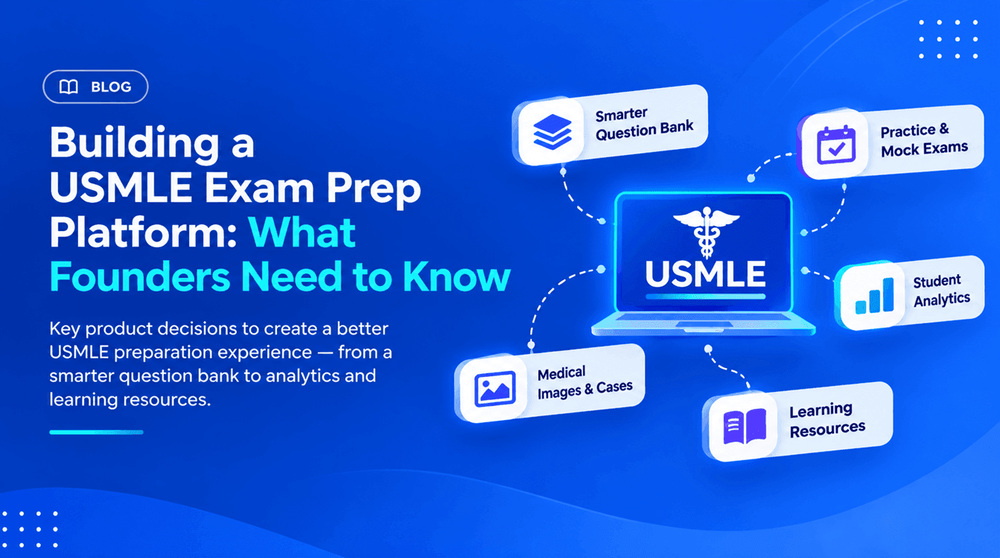
Building a USMLE exam prep platform involves more than putting questions online. The platform needs to manage medical content, deliver reliable practice sessions, track student performance, and support the business behind it.
The difficult part is making these components work together. A question bank may be manageable with a few hundred questions, but adding thousands of questions, clinical images, mock exams, subscriptions, and student records introduces new challenges.
Here are 12 areas to consider when planning your platform.
1. Define What Your First Version Needs
Before choosing technology, decide what students and administrators need to do in the first version.
For example, an initial release might include student accounts, a categorized question bank, explanations, practice sessions, basic performance reports, and an admin portal. Full-length mock exams, advanced analytics, and personalized recommendations could follow in later phases if they aren't essential to the launch.
This approach helps control scope without creating a technical foundation that needs to be replaced as the product grows.
Practical consideration: Prioritize features by business value, student need, and implementation effort - not simply by the number of features competitors offer.
2. Design the Question Bank Data Structure
A question bank needs a consistent structure for storing and retrieving educational content. A question may contain:
- Question text and answer options
- Correct answer and explanation
- Subject, topic, and subtopic
- Difficulty and relevant tags
- Associated clinical images or other media
- Publication status and review information
These fields make it possible to assemble topic-based practice sessions, filter questions, manage content updates, and report performance consistently.
For example, if a student selects a particular topic, the platform should be able to retrieve the appropriate questions using their classifications rather than relying on manually created question lists.
Practical consideration: Plan for question revisions and content review from the beginning. Updating a question should not unintentionally break its references, historical attempts, or performance reports.

3. Build a Manageable Medical Content Library
Medical content often extends beyond individual questions. A platform may include clinical images, diagrams, educational articles, explanations, and reference material.
Plan how content will be uploaded, categorized, reviewed, published, and updated. Questions and learning resources should be linked in a consistent way so students can find relevant material without duplicating the same content unnecessarily.
If the platform contains thousands of image-supported questions, media storage, image delivery, and content administration become important parts of the design.
Practical consideration: Separate content management from the student-facing experience. Editors should be able to make routine updates without requiring a developer for every change.
4. Support Flexible Question Practice
Students may want to practice by subject, topic, difficulty, or other available filters.
The practice engine needs to select the right questions, record responses, show explanations at the appropriate time, and preserve relevant session history.
It should also handle practical cases such as a student leaving a session, returning later, or attempting a question more than once.
Practical consideration: Decide how question selection works before developing the interface. The rules for selecting, repeating, and recording questions affect the question bank, session logic, and analytics.
5. Build Mock Exams as a Separate Workflow
Topic-based practice and timed mock exams have different requirements. Practice sessions may prioritize explanations and repeated attempts. Mock exams typically need a defined question set, timing rules, navigation, answer submission, scoring, and a result summary.
The platform should also handle interruptions and submissions carefully. For example, refreshing a page should not accidentally submit an exam twice or lose answers that have already been saved.
For examination-specific requirements, refer to the official USMLE Step 1 exam content and specifications. Use the current official guidance when configuring an exam experience; don't assume a practice platform should reproduce every detail of the official testing system.
Practical consideration: Define the exam rules separately from the visual interface so they can be tested and maintained consistently.
6. Make Student Analytics Depend on Reliable Data
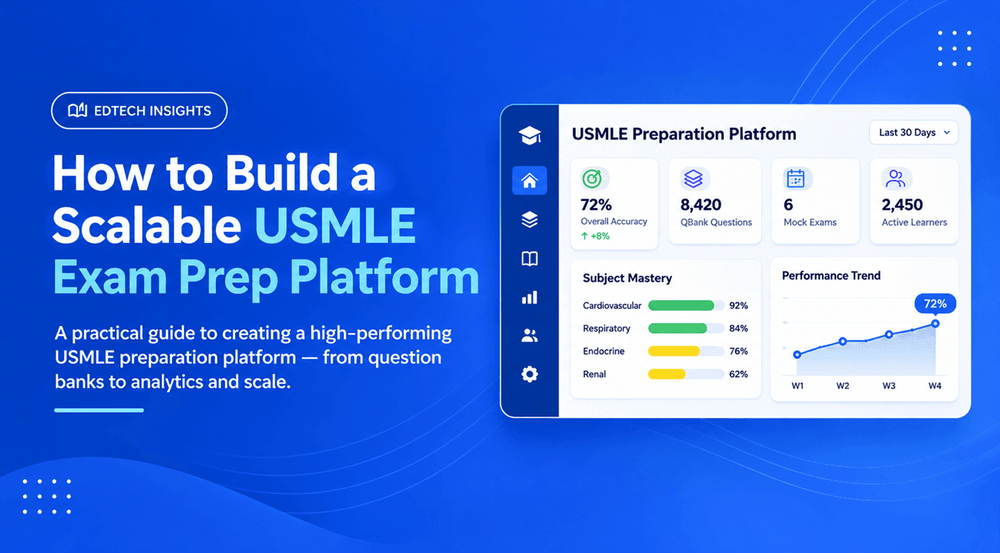
Student analytics are only as useful as the data behind them. A platform might report overall accuracy, performance by topic, attempt history, and changes over time. These reports can help students understand where they may need additional practice.
But misleading classifications or inconsistent scoring can make a report unreliable. If questions are assigned to the wrong topic, topic-level performance becomes less meaningful.
Practical consideration: Establish consistent topic classifications and scoring rules before building advanced dashboards. More charts do not automatically mean better insights.

7. Build Separate Student and Admin Experiences
Students and administrators use the platform for different purposes. The student portal should make it easy to find practice sessions, exams, learning resources, subscriptions, and results. The admin portal needs workflows for managing questions, reviewing content, handling users, and maintaining platform settings.
These interfaces can share the same underlying services and data without forcing both audiences into the same workflow.
Practical consideration: Design administrative tasks around the people who will actually perform them. A content editor should not need technical assistance for routine publishing work.
Want us to build this for you?
Infynno builds AI-powered software for EdTech, enterprise, and SaaS teams. Free discovery call · NDA first.
8. Plan User Roles and Content Review
Not every user should have the same permissions. A content editor may draft a question, while a reviewer checks its accuracy before publication. An administrator may manage accounts and settings, while students can access only the features available to their accounts.
A clear permission model reduces accidental changes and helps organize content review.
Practical consideration: Define who can create, edit, approve, publish, and remove content. Use server-side permission checks rather than relying only on hiding controls in the interface.
9. Connect Subscriptions to Platform Access
If the business uses paid subscriptions, payment processing and user access must work together.
Consider what happens when a payment succeeds, a renewal fails, a subscription expires, or a user cancels. The platform should apply the correct access rules and provide administrators with a clear way to resolve exceptions.
Payment status and learning access should not depend solely on what the browser displays. Access decisions need to be enforced by the backend.
Practical consideration: Map the subscription lifecycle before integrating a payment provider. This helps prevent users from losing valid access or retaining paid features after their entitlement has ended.
10. Choose an Architecture That Can Grow
Scalability is not simply about selecting a particular framework or adopting microservices. The architecture should support the platform's expected workload, content volume, integrations, and development team. Important areas include database design, API performance, image delivery, background processing, logging, backups, and monitoring.
A well-structured application can often be a sensible starting point. Components can be separated further when measured workload or operational needs justify the additional complexity.
For a related example, see our scalable exam preparation platform case study.
Practical consideration: Identify likely bottlenecks and measure actual performance before making major architectural changes.
11. Protect Student Data and Educational Content
Exam preparation platforms may store personal information, learning histories, account details, and proprietary educational content.
Security planning should include authentication, server-side authorization, secure data handling, protected administrative functions, backups, and monitoring. Payment integrations should follow the provider's security guidance and applicable requirements.
Privacy obligations can vary by audience, jurisdiction, and the types of data collected. Review those requirements before launch rather than assuming one set of controls meets every obligation.
Practical consideration: Collect only the information the platform needs, restrict access appropriately, and define how long records are retained.
12. Test the Platform Before and After Launch
Testing should cover more than whether a question displays correctly. Check question selection, answer validation, scoring, timed exams, interrupted sessions, duplicate submissions, permissions, subscription changes, and mobile usability.
Also test the platform under an expected level of concurrent usage. A feature that works for one student may behave differently when many students submit answers or start exams simultaneously.
After launch, monitor errors, performance, support requests, and actual usage. Use those findings to prioritize improvements.
Practical consideration: Test important business workflows end to end - not just individual screens or components.
Development Experience: Feedback From Our Client
Building an exam preparation platform requires more than implementing a list of features. It also requires understanding the product, researching industry practices, and identifying opportunities to improve the solution.
In a five-star Clutch review, our client highlighted Infynno's research, industry understanding, and recommendations beyond the original requirements.
This feedback reflects our approach to custom software development: understand the business needs first, then build a solution around them.
Final Thoughts
A scalable USMLE exam prep platform depends on how well its question bank, medical content, practice engine, analytics, administration, and subscriptions work together.
You don't need to build every possible feature at launch. Start with the core requirements, establish a maintainable foundation, and expand based on business priorities and student feedback.
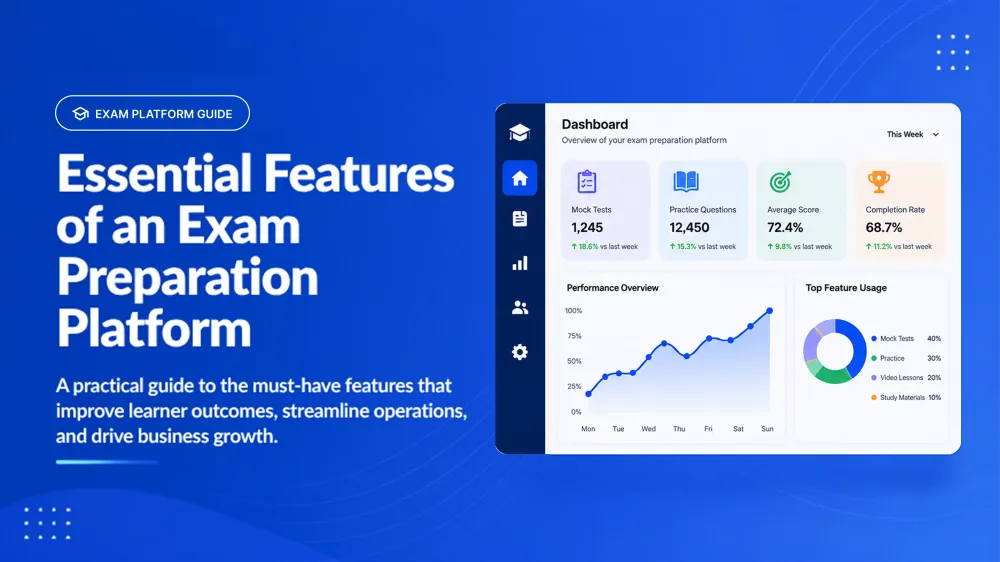
If you're evaluating which features to prioritize, read our guide to the essential features of an exam preparation platform.
Planning to Build a Medical Exam Prep Platform?
Infynno Solutions builds custom medical learning and exam preparation platforms tailored to business requirements. Explore our medical exam app development services.
Infynno Solutions LLP is an independent software development company and is not affiliated with or endorsed by USMLE.