Introduction
For years, a large question bank was one of the biggest selling points of a medical exam preparation course. More questions meant more practice, more explanations, and more opportunities to prepare.
But expectations are changing. Students preparing for demanding medical examinations such as UCAT, USMLE, MCAT, and other professional entrance exams have access to multiple preparation resources. They can find practice questions, explanations, video lessons, and study materials from different providers.
Simply offering thousands of questions is no longer enough to make a preparation platform stand out.
Students want to understand where they are struggling, what they should practice next, and whether their preparation is moving in the right direction.
This is where adaptive question banks create a new opportunity for medical exam prep businesses.
1. Why Static Question Banks Are Losing Their Appeal
A traditional question bank generally allows students to select a subject, choose a topic, and start answering questions. It works, but it often leaves students responsible for deciding what to practice next.
Consider two students preparing for the same examination.
- Student A consistently performs well in cardiovascular questions but struggles with renal physiology.
- Student B has strong renal knowledge but repeatedly makes mistakes in cardiovascular questions.
If both students receive the same practice experience, much of their study time may be spent answering questions they already understand. A better platform should recognize these differences.
Instead of simply showing students more questions, it should help them identify knowledge gaps and make their practice more relevant.
Opportunity for founders: Move from selling access to a question collection toward offering a more personalized preparation experience.
2. What Makes a Question Bank Adaptive?
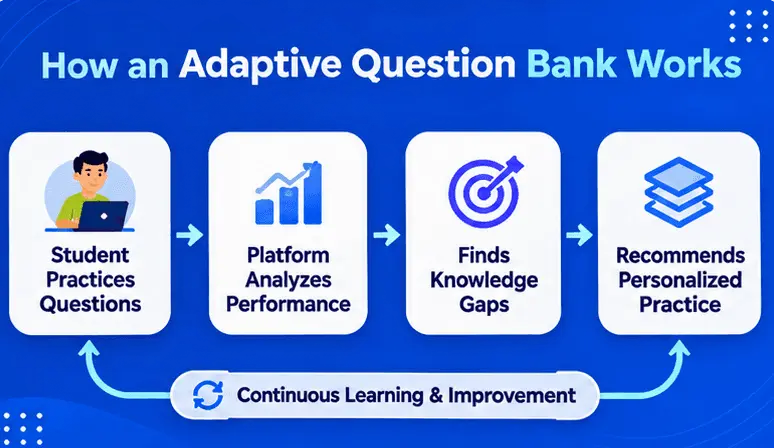
An adaptive question bank uses student performance and learning history to influence what happens next. Rather than presenting every student with the same sequence of questions, the platform can use available data to personalize practice.
For example, it may consider:
- Previous answers and accuracy.
- Topics where students repeatedly make mistakes.
- Question difficulty.
- Time taken to answer.
- Previous attempts and review history.
- Topics that have not been practiced recently.
Based on these signals, the system can recommend questions, adjust practice difficulty, or encourage students to revisit particular concepts. Not every personalized question bank needs a sophisticated AI model. A well-designed rules-based recommendation engine can provide meaningful personalization.
The important part is having reliable question data and a clear understanding of how the platform should respond to student performance.
3. Build Practice Around Knowledge Gaps
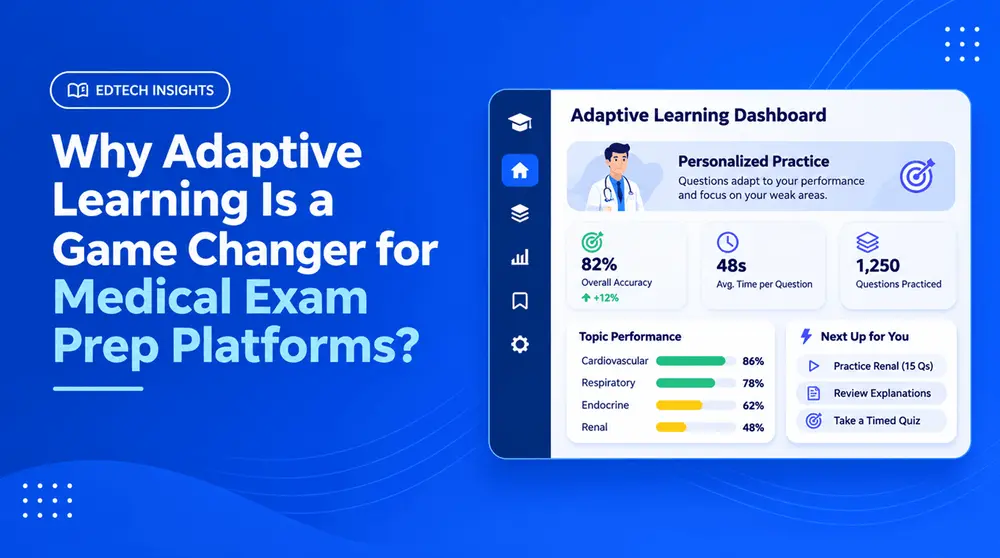
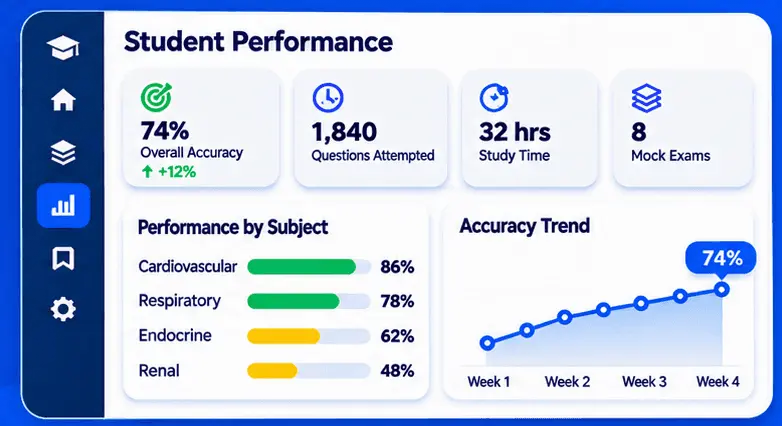
One of the most useful applications of adaptive learning is identifying weak areas. For example, imagine a student has completed 100 questions across different subjects.
Illustrative performance breakdown
| Subject | Accuracy | Suggested action |
|---|---|---|
| Cardiovascular | 86% | Maintain practice |
| Respiratory | 78% | Continue reviewing |
| Endocrine | 62% | Targeted practice |
| Renal | 48% | Priority review |
Instead of simply displaying these numbers, the platform can turn them into practical study recommendations.
For example:
- Review renal physiology explanations.
- Attempt 15 targeted renal questions.
- Revisit previously incorrect questions.
- Take another mixed-topic assessment after practice.
This creates a connection between performance reporting and the next learning activity. For founders, this is important: analytics become more valuable when they influence what students actually do next.
4. Make Question Difficulty Responsive
Not every student needs the same level of challenge. A beginner may need foundational questions with detailed explanations, while a more advanced candidate may benefit from challenging clinical scenarios.
A question bank can use performance history to recommend suitable difficulty levels.
For example:
- Begin with a diagnostic set.
- Identify the student's current performance.
- Recommend questions at an appropriate difficulty.
- Increase the challenge as performance improves.
- Revisit concepts when mistakes continue.
This doesn't mean every correct answer should automatically trigger a harder question. A single response is not enough to establish mastery. The system should consider patterns across multiple attempts and topics.
Product consideration: Make difficulty levels consistent and reviewable. Poorly classified questions can lead to inappropriate recommendations.
5. Use Timed Practice to Build Exam Readiness
Knowing an answer and answering it under time pressure are different skills. Medical candidates need opportunities to practice managing time, particularly when examinations involve large question sets and sustained concentration.
A modern platform can introduce different timing experiences:
- Quick drills: Short, sub-minute countdowns for focused recall or rapid decision-making.
- Topic practice: Flexible sessions where students can concentrate on understanding explanations.
- Timed question sets: Practice with a defined time allowance.
- Full mock exams: Longer sessions that simulate the relevant examination conditions.
When designing exam-specific practice experiences, refer to the official USMLE examination resources to understand the applicable examination structure and requirements.
Short countdown timers can make focused drills more engaging, but they should not be imposed on every question. Students also need enough time to understand complex clinical scenarios.
The platform should make timing configurable according to the activity.
Business opportunity: A combination of flexible practice and realistic timed assessments can make a preparation platform more useful than a basic question library.
6. Turn Explanations into a Learning Experience
A correct or incorrect indicator is not enough. Students need to understand why an answer is correct and why the alternatives are less appropriate.
A useful preoperative review experience may include:
- Detailed answer explanations.
- Clinical images and diagrams.
- Highlighting important information.
- Strike-through for eliminating answer options.
- Personal notes and question flags.
- Links to relevant learning resources.
These features help students interact with questions rather than simply moving from one question to another.
They also create opportunities to connect the question bank with a wider medical learning library. Explore the essential features of an exam preparation platform to understand how these capabilities fit into a complete learning product.
For platform owners, this means content management should be considered alongside question delivery. Questions, images, explanations, and reference materials need to work together.
Want us to build this for you?
Infynno builds AI-powered software for EdTech, enterprise, and SaaS teams. Free discovery call · NDA first.
7. Give Students More Than an Overall Score
A dashboard showing an overall accuracy percentage is a useful starting point, but it rarely explains the full picture. A stronger analytics experience can show:
- Accuracy by subject and topic.
- Performance across previous attempts.
- Changes in accuracy over time.
- Average response time.
- Questions answered and reviewed.
- Strong and weak areas.
- Progress through mock exams.
The next step is turning this information into recommendations.
For example, instead of displaying: Renal physiology: 52% accuracy
The platform could suggest: Your renal physiology accuracy is below your recent performance in other subjects. Review the related explanations and try a focused practice set.
Recommendations should be based on actual student data, not generic automated messages. Building these capabilities requires a reliable technical foundation. See how we approached building a scalable exam preparation platform in one of our development projects.
The key principle: Don't just show students what happened. Help them understand what they can do next.
8. Use Spaced Review to Bring Students Back to Important Questions
Students often forget material they previously understood, especially when preparing across multiple subjects. A question bank can support revision by identifying questions that students answered incorrectly, flagged for review, or have not revisited for some time.
A spaced review workflow might:
- Identify questions that need another attempt.
- Prioritize topics with repeated mistakes.
- Schedule revision at suitable intervals.
- Track whether performance improves on later attempts.
This can make previously completed questions useful again rather than treating every question as a one-time activity.
For founders, it also creates a reason for students to return to the platform throughout their preparation journey.
9. Where AI Can Improve the Experience
AI creates opportunities to make question banks more responsive, but it should solve specific learning and operational problems rather than being added simply as a marketing feature.
Potential applications include:
- Recommending practices based on performance history.
- Summarizing recurring weak areas.
- Helping students navigate explanations.
- Suggesting relevant learning resources.
- Supporting content tagging and administration.
However, AI-generated medical explanations and educational content need appropriate expert review. Incorrect recommendations or inaccurate medical information can damage student trust.
A sensible approach is to establish reliable question data and performance tracking first, then introduce AI where it provides measurable value.
11. What Founders Should Consider When Building an Adaptive QBank
Building an adaptive question bank requires planning across several connected components.
Before development begins, consider:
- Question data structure: Can every question be classified by subject, topic, difficulty, and relevant skills?
- Performance tracking: Does the platform reliably record attempts, answers, timing, and review history?
- Recommendation logic: Are recommendations based on clear rules and meaningful performance patterns?
- Content management: Can your team update questions, explanations, and medical images without unnecessary developer involvement?
- Student experience: Can students understand why particular questions or topics are being recommended?
- Scalability: Can the system handle growing question volumes, student activity, and analytics workloads?
These decisions are easier to address when the question bank, practice engine, analytics, and content management system are planned together. If you're exploring USMLE platform development, these are some of the technical foundations worth planning early.
12. Start with a Strong Foundation, Then Make It Smarter
Not every medical exam preparation business needs a complex adaptive learning engine from day one.
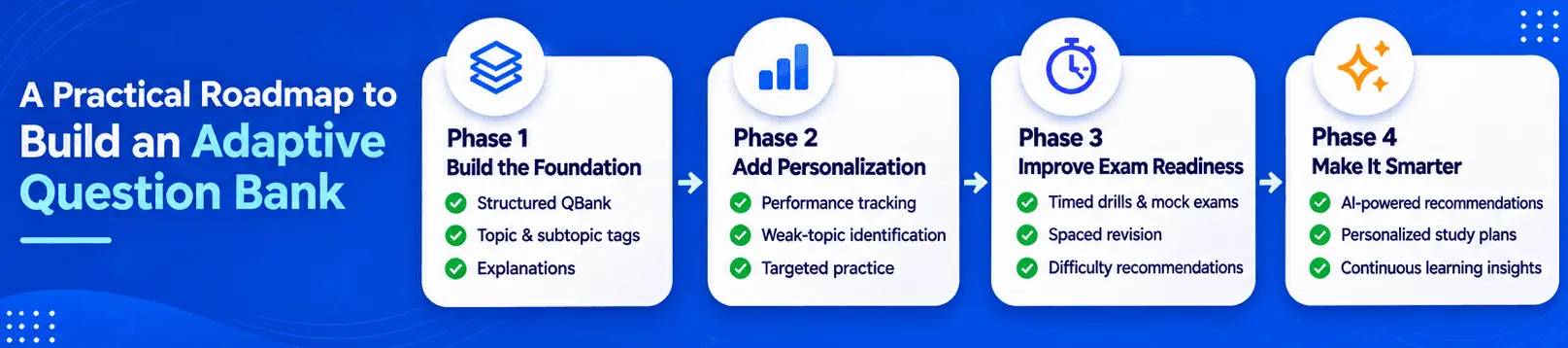
A practical development roadmap could look like this:
| Phase | What to build |
|---|---|
| Foundation | Structured QBank, topic filters, explanations, student accounts |
| Personalization | Performance tracking, weak-topic identification, targeted practice |
| Advanced learning | Spaced revision, difficulty recommendations, timed drills |
| Intelligent features | AI-assisted recommendations and personalized learning support |
This allows the business to launch with a useful product, gather real student data, and improve the experience based on actual usage.
It also avoids investing heavily in recommendation systems before the platform has enough reliable data to support them.
Final Thoughts: The Question Bank Is Becoming the Learning Engine
The next generation of medical exam preparation platforms will compete on more than the size of their question libraries. Students want relevant practice, useful feedback, better visibility into their progress, and tools that help them use their preparation time effectively.
For founders, this creates an opportunity to build more valuable products around the question bank itself. A well-designed adaptive system can connect questions, performance data, revision, explanations, and recommendations into one continuous learning experience.
The question is no longer just how many questions your platform offers. It's how intelligently your platform helps students use them.
Planning to Build a Smarter Medical Exam Prep Platform?
At Infynno Solutions, we build custom exam preparation platforms with structured question banks, mock exams, student analytics, personalized learning features, and AI-enabled workflows.
Whether you're launching a new medical exam prep product or upgrading an existing platform, we can help you plan and build the right technology. Explore our Medical Exam App Development Services.