Introduction
For years, EdTech businesses built their value around access to educational content: recorded lectures, question banks, homework solutions, mock exams, and expert explanations. Students paid for resources that helped them understand concepts, practice questions, and prepare for exams.
That model is not disappearing overnight. But the value of information alone is becoming harder to defend.
Today, students can ask ChatGPT or Gemini, or Claude to explain a difficult concept, solve a question, generate practice exercises, or clarify a mistake within seconds. They don't necessarily need to open a dedicated learning platform for every question.
For established EdTech founders, this raises an important question: If students can access answers almost anywhere, what makes your platform worth returning to?
Chegg Is a Warning, Not the Whole Story
Chegg offers an important example of the pressures facing education businesses built around access to academic help. In its 2025 full-year results, Chegg reported that total revenue declined 39% year over year, from $617.6 million in 2024 to $376.9 million in 2025.
AI is not the only factor behind Chegg's challenges, and its experience does not mean every EdTech business will follow the same path. However, it illustrates why founders should examine which parts of their value proposition are becoming easier to replace. Read Chegg's 2025 financial results.
If your main selling point is simply providing explanations, practice questions, or access to information, a general-purpose AI tool may already offer a credible alternative. The question is whether your platform provides something more valuable than access alone.
What Should EdTech Platforms Offer Instead?
The opportunity is to move from providing educational content to helping students make measurable progress.
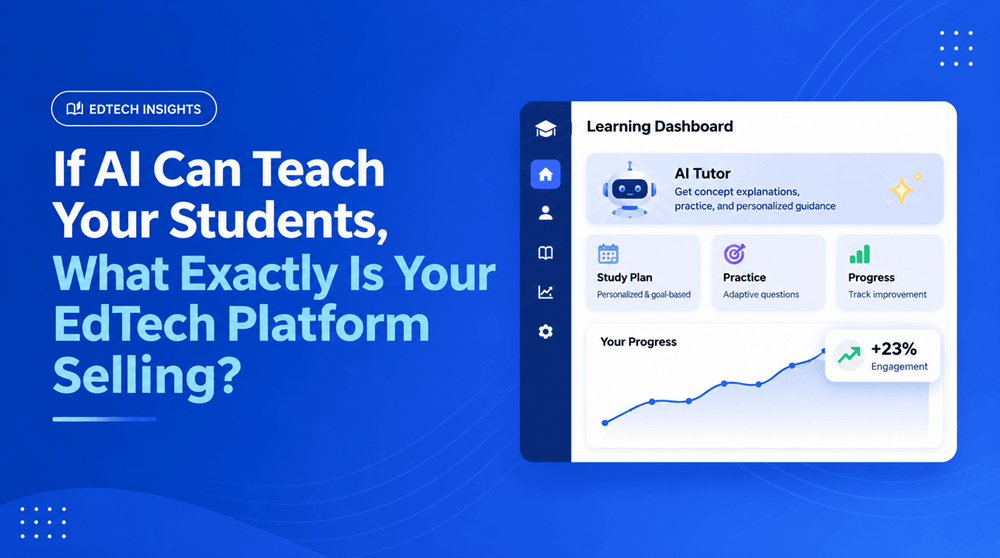
Consider an exam preparation platform. A question bank gives students questions to solve. A more valuable learning system can identify recurring mistakes, distinguish knowledge gaps from time-management problems, recommend what to practice next, and track whether the student is improving.
The same principle applies to tutoring platforms, homework systems, medical education, and professional interview preparation. Students need more than answers. They need direction, reliable feedback, consistency, and a clear understanding of their progress.
AI can help deliver these experiences when it is designed around the learning process rather than added as a standalone chatbot. For example, an AI tutor grounded in verified course material can help students understand concepts in context. Personalized practice can adapt to demonstrated weaknesses, while progress analytics can turn assessment results into actionable recommendations.
However, these capabilities are not automatically effective simply because they use AI. Their value depends on content quality, sound learning design, accurate feedback, and whether students actually benefit from using them.
Want us to build this for you?
Infynno builds AI-powered software for EdTech, enterprise, and SaaS teams. Free discovery call · NDA first.
You Don't Necessarily Need to Rebuild Your Platform
One common mistake is assuming that responding to AI disruption requires replacing an existing learning management system, question bank, or assessment platform.
Often, a better first step is to audit what already exists. Your platform may contain years of valuable educational content, student performance data, and established learning workflows. The opportunity may be to connect these assets more intelligently rather than start again.
For example, an established platform could introduce AI-powered learning gap analysis, personalized practice recommendations, or more interactive ways for students to use existing course materials. A coaching institute might benefit more from helping students follow a structured learning plan than from adding another general-purpose chatbot.
At Infynno, we work on education technology, including exam preparation platforms and AI-enabled learning experiences. Depending on the existing product and its needs, founders can explore AI integration for education platforms, exam preparation platform development, or EdTech mobile app development.
The important point is to begin with a specific student or business problem, not a list of AI features.
What Should EdTech Founders Do Now?
If you already operate an EdTech platform, start by asking three questions.
1. What can students now do outside your platform?
Identify the features that general-purpose AI tools can replicate easily. This helps reveal where your differentiation may be weakening and where your platform needs to deliver additional value.
2. What valuable assets are you underusing?
Review your existing content, assessments, learning history, and teaching expertise. Could these assets support more personalized practice, better feedback, or more interactive learning experiences? You may already have much of what you need to start testing an improvement.
3. How will you measure improvement?
Before building an AI feature, define the intended outcome. It might be better practice completion, fewer recurring mistakes, improved assessment performance, reduced educator workload, or stronger student retention. Establish a baseline and test whether the change delivers the intended result.
You do not need to implement every AI capability at once. Start with the opportunity that solves a meaningful problem for your students and your business.
AI adoption in education also requires careful consideration of privacy, accuracy, and educator oversight. UNESCO's guidance on generative AI in education and research provides a useful reference for evaluating these responsibilities.
The Real Competitive Advantage in EdTech
AI makes it easier to generate explanations, questions, and educational content. That creates opportunities for founders, but it also reduces the value of relying on content access alone.
The stronger opportunity is to build a system that helps students understand what they need to learn, decide what to do next, receive reliable feedback, and see whether their efforts are working.
AI may make educational content easier to access. Your platform must make learning more valuable.
For established EdTech founders, the question is no longer simply whether to add AI. It is where AI can create a meaningful advantage - and how to prove that advantage through better learning experiences and measurable outcomes.
Start by identifying one part of your existing learning journey that could become more personalized, useful, or measurable. Test the change, evaluate the results, and expand only when you have evidence that it creates value.
You may not need an entirely new platform. You may need to rethink what your existing platform helps students achieve.