Why Hotel Mobile Apps Often Fail
Native hotel apps have a structural adoption problem that has nothing to do with how well they're built:
- Guests don't download apps for short stays. A guest checking in for two or three nights has little incentive to use precious phone storage and go through an app store download for a single hotel visit.
- App store friction kills adoption before it starts. Every extra tap between a guest and the experience you built - find the app, download it, create an account - loses a meaningful percentage of guests.
- Maintenance never stops. iOS and Android updates, app store review cycles, and two separate codebases mean an app is an ongoing cost commitment, not a one-time build.
- Most hotel apps see single-digit adoption rates. The investment goes toward a feature the majority of guests never open, while the front desk keeps fielding the same questions the app was supposed to answer.
None of this means digital guest experience doesn't work - it means the delivery mechanism matters as much as the content inside it.
What Modern Guests Actually Expect
Guest expectations have shifted, but not necessarily toward "there should be an app for this." What guests actually want is closer to:
- Instant access, no friction - information available the moment they need it, without downloading anything
- Answers without waiting on hold or a busy front desk
- Local recommendations that feel curated, not a generic list of nearby attractions
- A way to communicate with staff that doesn't require picking up a phone
- Self-service for the basics - Wi-Fi password, checkout time, amenity hours - so a human isn't needed for every small question
Guests want the experience a good app promises - speed, personalization, self-service - without the friction of getting an app in the first place. That distinction is exactly where QR codes and Progressive Web Apps come in.
A Smarter Alternative: QR Codes & Progressive Web Apps (PWAs)
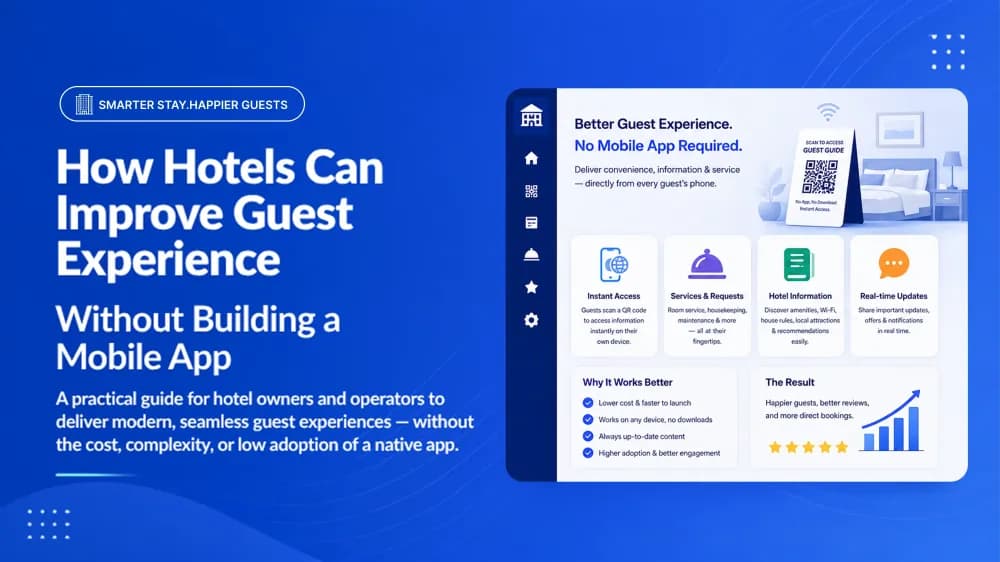
A Progressive Web App is a web-based experience that behaves like a native app - fast, installable to a home screen, capable of offline access and push notifications - but runs entirely in a guest's browser. Combined with a QR code, it becomes the fastest path from "guest checks in" to "guest is using your digital experience":
- Guest scans a QR code at check-in, on a room card, or in a welcome email
- The guest experience opens instantly in their browser - no app store, no download, no account creation required
- The experience feels app-like - smooth navigation, offline-tolerant content, and the option to add it to their home screen if they want quick access again later
- One platform works across every device, since it's browser-based rather than built separately for iOS and Android
This is precisely the model behind GuestBrief, a digital guest experience platform we built as a PWA - guests get full contact-free access to property and local information with just a QR code scan, no app download required.
Key Features of a Digital Guest Experience Platform
A well-built browser-based guest experience typically includes:
- QR-Based Digital Guest Guides - Property information, amenities, and house rules accessible instantly
- Guest Self-Service - Wi-Fi details, checkout times, and common questions answered without staff involvement
- Guest Communication - Direct, in-platform messaging between guests and staff, routed to the right department
- AI-Powered Recommendations - Local dining, activities, and experiences suggested based on guest interests
- Digital Concierge / AI Concierge - A conversational assistant for guest questions, available beyond front-desk hours
- Multi-Property Content Management - For hotel groups, centralized content and branding management across every property
- Mobile-First Design - Built for the phone in a guest's hand, since that's how the experience is almost always accessed
Business Benefits for Hotels
- Lower development and maintenance cost - one browser-based platform instead of two native app codebases
- Higher guest adoption - removing the download step measurably increases actual usage
- Reduced front-desk load - self-service and digital concierge features absorb the repetitive questions that otherwise interrupt staff
- Faster time to market - PWAs typically launch faster than native apps, since there's no app store review process
- Easier content updates - property and local content can be updated instantly, without pushing an app update through app stores
- Better guest data - a well-built guest platform captures preference and behavior data that improves personalization over time
Want us to build this for you?
Infynno builds AI-powered software for EdTech, enterprise, and SaaS teams. Free discovery call · NDA first.
AI in Modern Guest Experiences
Layering AI onto a browser-based guest platform is where the experience starts to feel genuinely modern rather than just digitized:
- AI Concierge answers guest questions instantly, extending coverage beyond staffed hours
- Personalized recommendations adapt to what a guest has shown interest in, rather than showing every guest the same static list
- AI day planning and itinerary suggestions turn a list of local attractions into something that actually feels curated for that guest's stay
We go deeper into how we implement AI responsibly across the guest journey - and where it should and shouldn't be used — in our guide on AI for Hospitality Platforms.
Native Apps vs. Progressive Web Apps
Native AppProgressive Web App (PWA)Guest accessApp store download requiredInstant, via QR code or linkDevelopment costHigher - often two codebasesLower - one codebase for all devicesMaintenanceOngoing app store compliance, OS updatesSimpler, single deploymentTypical adoption for short staysLowSignificantly higherOffline supportFull native capabilityStrong, via modern browser capabilitiesBest fitLoyalty-driven brands with frequent repeat guestsMost hotels and short-stay properties
When Hotels Still Need a Native App
A PWA is the better default for most hospitality businesses, but native apps still make sense in specific cases:
- Loyalty-driven hotel groups where guests stay frequently enough to justify keeping an app installed long-term
- Properties needing deep device integration - features like Bluetooth room-key unlocking that depend on native device APIs
- Brands where the app itself is part of the loyalty proposition, not just a delivery mechanism for information
For everyone else - independent hotels, boutique properties, and most short-stay accommodations - a PWA delivers the same guest-facing experience at a fraction of the cost and with meaningfully better adoption.
Choosing the Right Digital Guest Experience Strategy
The right approach depends less on "what's trendy" and more on a few honest questions:
- How often do the same guests return? (Frequent repeat guests lean native; infrequent stays lean PWA)
- How much of your guest volume is short-stay versus extended stay?
- Do you need native device features, or is browser-based access enough?
- What's your realistic budget for ongoing maintenance, not just initial build?
For most hotels, independent properties, and even multi-property groups, the answer lands on a PWA-based digital guest experience - lower cost, faster launch, and adoption rates a native app rarely matches for short-stay guests.
Frequently Asked Questions
Is a PWA less "real" than a native app? No - a well-built PWA offers app-like speed, offline support, and home-screen installation. The difference is invisible to most guests; they just experience a fast, no-download guest guide.
Can a PWA send push notifications like a native app? Yes, modern PWAs support push notifications on most platforms, though iOS support has historically been more limited than Android. We'll walk through current platform capabilities during scoping.
Will guests actually use a QR-based guest guide? Adoption is typically significantly higher than native apps, precisely because there's no download step - guests scan and they're in.
Can we add AI features to a PWA-based guest guide? Yes. AI concierge, personalized recommendations, and itinerary planning all work within a PWA - see our AI for Hospitality Platforms guide for details.
How much does a PWA-based guest experience platform cost compared to a native app? Typically significantly less, since it's one codebase instead of two, with no app store fees. See our full hospitality software development cost guide for detailed ranges.
Can this work across multiple properties in our group? Yes - multi-property content management, with per-property branding and centralized administration, is a core capability we build into hospitality platforms for hotel groups.
Ready to Improve Your Guest Experience?
If your hotel is weighing an app investment, it's worth a conversation before committing to native development. We've built this exact kind of platform before - see GuestBrief, our digital guest experience case study, or explore our full Hospitality Platform Development services.