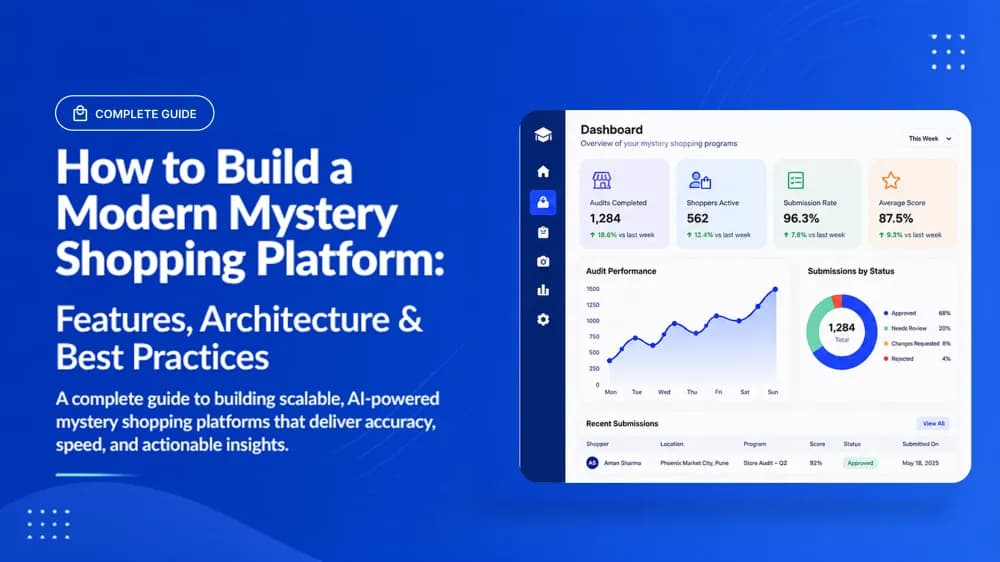
Why Modern Mystery Shopping Platforms Matter
Client expectations for mystery shopping and retail audit software have shifted. A client signing a mystery shopping contract today expects:
- Enterprise reporting they can drill into themselves, not a monthly PDF export
- Consistent data quality across every shopper and every location, not just the ones a reviewer happened to catch on a good day
- Fast turnaround from submission to client-visible report
- Business intelligence, not just raw scores - trend analysis, location comparisons, and operational recommendations
Platforms that still run on manual spreadsheets and email-based proofreading simply can't deliver this at scale. The businesses winning larger, more sophisticated clients are the ones whose software does the heavy lifting on data quality and reporting, freeing their operations team to focus on client relationships instead of chasing paperwork.
Common Operational Challenges
Before designing a platform, it's worth being honest about where mystery shopping operations actually break down:
- Proofreading bottlenecks - submission volume grows faster than review headcount, and quality control becomes the ceiling on how many clients you can serve
- Inconsistent shopper reliability - some shoppers deliver excellent, detailed reports; others submit the bare minimum, and manually tracking who's who doesn't scale
- Reimbursement complexity - shoppers often need to be reimbursed for purchases in addition to being paid a fee, and reconciling receipts, amounts, and payment timing manually is a common source of errors and shopper frustration
- Fragmented tooling - forms in one tool, payments in another, reporting built manually in spreadsheets, none of it talking to each other
- Multi-client complexity - each client often wants their own checklist, their own branding, and their own reporting cadence, which a single-client-designed system handles poorly
A platform built to address these specifically - rather than a generic form-builder repurposed for mystery shopping - is what separates a system that scales from one that becomes its own operational burden.
Essential Platform Features
A genuinely modern mystery shopping platform needs to cover the full lifecycle of an audit program, not just the shopper-facing form:
- Survey Management - dynamic, conditional-logic checklist and survey builders, so each client's audit methodology can be configured without custom code per client
- Campaign Management - creating, scheduling, and managing audit programs (campaigns) across locations, time windows, and shopper pools
- Shopper Portal - where shoppers find jobs, submit evidence-backed reports, and track payments and reimbursements
- Client Portal - enterprise-grade dashboards where clients view scores, trends, and exportable reports
- Proofreader Portal - a dedicated interface for the review/QA team, separate from general admin functions, optimized for fast, accurate report review
- Reimbursement Management - structured handling of shopper purchase reimbursements alongside job payment, with receipt capture and reconciliation
- Enterprise Reporting - exportable, filterable reporting built for enterprise clients' own internal review processes, not just in-app dashboards
- Role-Based Access Control (RBAC) - distinct permission levels for shoppers, proofreaders, client users, and internal admins, each seeing only what's relevant to their role
- API Integrations - connections to payment processors, payroll systems, CRMs, and in some cases client-side POS or compliance systems
- Operational Analytics & Business Intelligence - pattern detection across shoppers, locations, and clients that surfaces operational insight, not just individual report data
Multi-Portal Architecture
This is the single biggest architectural decision in building a mystery shopping platform, and it's where a lot of early-stage builds get it wrong by treating everything as one admin panel with different views.
A properly architected platform typically has three to four distinct portals:
- Shopper Portal - mobile-first, built for finding jobs, capturing photo/GPS/receipt evidence in the field, and tracking payment and reimbursement status
- Client Portal - web-based, built for enterprise reporting, drill-down analysis, and multi-location comparisons, often white-labeled per client
- Proofreader Portal - a focused, high-throughput interface for the QA team to review submissions quickly and consistently, distinct from general admin tooling
- Admin/Operations Portal - campaign management, shopper recruitment and management, client program configuration, and system-wide reporting
Each portal has different UX requirements, different data access needs, and different performance characteristics - a shopper submitting a report in the field needs offline-tolerant mobile UX, while a proofreader working through a review queue needs a fast, keyboard-friendly desktop interface. Trying to serve all of these from one generic interface is where usability - and eventually data quality - breaks down.
Technically, this means role-based access control isn't an afterthought bolted onto a single application; it's a foundational architecture decision that determines how each portal is built and deployed.
AI in Mystery Shopping
AI-assisted quality reviews are increasingly a baseline expectation, not a differentiator - but they only work well when layered onto a platform with clean, consistent data structure underneath. In practice, this means:
- AI-assisted first-pass review of submissions for completeness and inconsistency, before they reach a human proofreader
- Automated evidence verification - checking that submitted photos match required evidence types
- AI-generated report summaries for client-facing dashboards
- Workflow automation for routing, reminders, and escalations, reducing manual operational overhead
The key design principle: AI should assist the proofreader portal's workflow, not attempt to replace the human decision entirely. We go into much more depth on how to implement this responsibly - including where AI adds real value versus where it introduces risk - in our dedicated guide, AI for Mystery Shopping Platforms.
Want us to build this for you?
Infynno builds AI-powered software for EdTech, enterprise, and SaaS teams. Free discovery call · NDA first.
Technical Architecture & Scalability
A few architectural decisions matter more than others when building for scale:
- Cloud infrastructure - AWS, Azure, or Google Cloud, chosen based on your compliance needs and existing enterprise client requirements, with infrastructure that can scale independently per portal under load
- API-first design - building a documented API layer from the start means client and admin portals, mobile apps, and future integrations can all consume the same backend without duplicated logic
- Database architecture - structured to support multi-tenant, multi-client data isolation from day one, even if you're launching with a single client
- Role-Based Access Control - implemented at the data layer, not just the UI layer, so permission logic can't be bypassed by a misconfigured screen
- Mobile architecture for the shopper portal - typically React Native or Flutter, with offline-tolerant data capture since shoppers often work in locations with unreliable connectivity
- Microservices vs. monolith - smaller platforms can start with a well-structured monolith; platforms expecting rapid multi-client growth benefit from splitting reporting, evidence storage, and payment processing into independently scalable services earlier
Getting these decisions right early avoids a costly re-architecture later - retrofitting multi-tenancy or proper RBAC onto a platform built for a single client is significantly more expensive than designing for it from the start, even if you only need it for one client at launch.
Build vs. Buy vs. White-Label
Most founders evaluate three paths:
- Build custom - full ownership, full customization, higher upfront investment
- License white-label/SaaS mystery shopping software - fastest to launch, lowest upfront cost, but limited customization and no ownership of the platform or client data architecture
- Partner with a development firm - a fully-owned custom platform without the overhead of hiring and managing an internal engineering team
White-label software is a reasonable way to validate the business model with minimal investment. Most agencies outgrow it once they need client-specific branding, custom checklist logic, or AI-assisted workflows tailored to their own methodology - at that point, the licensing model that got them started starts working against them. We break down the cost implications of each path in detail in our mystery shopping software development cost guide.
Common Mistakes to Avoid
- Designing one generic portal instead of purpose-built ones. A single admin panel with different "views" for shoppers, clients, and proofreaders creates UX and permission problems that compound as you scale.
- Treating RBAC as a UI feature instead of a data-layer control. Permission logic implemented only at the interface level is a security and data-integrity risk once you have multiple clients' data on one platform.
- Delaying multi-tenant architecture. It's tempting to build for your first client only, but retrofitting multi-client support later is far more disruptive than designing for it from day one.
- Bolting AI onto an inconsistent workflow. AI-assisted proofreading depends on clean, structured submission data - adding AI before your checklist and evidence structure is stable means rebuilding the AI layer later.
- Underestimating reimbursement complexity. Shopper reimbursements involve receipts, variable amounts, and reconciliation - treating this as a simple extension of payment processing usually leads to rework.
- Skipping business intelligence until "later." Operational analytics are much easier to build in from the start than to retrofit onto years of unstructured historical data.
Best Practices for Success
- Validate the core workflow first - job assignment, submission, and review - before investing in AI or multi-tenancy
- Design for multi-client architecture from day one, even if you're launching with a single client
- Give the proofreader portal as much UX attention as the shopper and client portals - it's the operational bottleneck most platforms underinvest in
- Build API-first so mobile apps, integrations, and future portals share one consistent backend
- Treat AI as an assistant to your review team, not a replacement - this protects data quality and keeps your team's trust in the platform
- Plan analytics and reporting infrastructure early, since retrofitting business intelligence onto unstructured historical data is expensive and often incomplete
Frequently Asked Questions
Do I need all three or four portals from day one? Not necessarily in full complexity, but architecting for them from the start matters more than building every feature immediately. A shopper submission flow, a proofreading queue, and a client view are the minimum viable version of each - the point is designing the data and permission structure so each can grow into a dedicated portal without a rebuild.
How is a mystery shopping platform different from a generic survey tool? Generic survey tools handle data collection but not the operational workflow around it - job assignment, evidence verification, proofreading queues, shopper payments and reimbursements, and client-specific reporting. A modern mystery shopping platform is closer to a purpose-built operations system than a form builder.
Should I add AI to my platform before or after I have real client volume? After your core workflow is stable and consistent. AI-assisted proofreading works best on structured, consistent submission data - adding it too early, while your checklist and evidence requirements are still evolving, usually means rebuilding the AI layer later.
How much does it cost to build something like this? It depends heavily on scope - how many portals, how much AI, how many integrations. We break this down in detail, with real cost ranges by stage, in our mystery shopping software development cost guide.
Can an existing mystery shopping platform be modernized instead of rebuilt? Often, yes. If the underlying data structure is reasonably organized, portals, AI features, and improved reporting can frequently be layered onto an existing system rather than requiring a full rebuild - this is something we assess during initial scoping.
Ready to Build Yours?
If you're past the "is this even a real business" stage and ready to build a platform that can actually support growth, we've done this before - including KPI Mystery Shopping, a live platform built on the same multi-portal, enterprise-reporting principles covered in this guide.
See the full breakdown of what we build on our Mystery Shopping Software Development page, or talk to our team directly.